Share article
Our Guide to Choosing, Using and Caring for Your Cookware
Everything you need to know to decide what cookware to invest in, and how to maintain and use your existing collection.
Share article

Choosing cookware: materials, size and daily usage
When choosing new cookware, the most important thing is to give proper thought to the type of cooking that you do on a day-to-day basis. Are you an everyday cook or a batch cooker? What kinds of meals do you cook the most? Do you have 2, 3, 4 or more people to cook for? Let this guide your choice of pan material and size.
Investing in pans for frying/sauteing, saucepans for boiling and simmering, a wok for stir-fries and curries and a grill or griddle pan will serve most households. If you do lots of batch cooking, a roasting dish or baking tray and a stock or casserole pot will also be useful.
Buying cookware online is the most common way to purchase it, but it can be difficult to know which size to opt for. Common diameter choices of pans are 19cm for saucepans and 28cm for frying pans, but it’s best to choose your size based on the portion size you cook most often. If you often cook in batches, go for a larger 23cm saucepan or a 25cm stockpot.
When building a collection, the easiest way is to start with a core set (including a frying pan, saucepan and stockpot). Investing in a stainless-steel or non-stick cookware set can be a great way to build this initial collection, as a set usually offers consistent performance and good value. If you have more specific needs, buying select pieces lets you tailor your collection to suit your individual cooking style.
The case for stainless steel
Stainless steel is the material favoured by professional chefs because it is durable, non-toxic and non-reactive. When used properly, stainless-steel cookware, such as our Space Steel Folding Handle 6-Piece Cookware set, will last for decades, so it’s a great investment. But you do need to know a few tips to have the easiest time with it.
Proper preheating is rule number one. Because stainless steel has tiny pores that food settles into (particularly proteins like eggs, meat and fish), you need to create a barrier to stop these chemical bonds from forming and fusing the proteins to the pan. You can do this by pre-heating the pan to the point that a few drops of water dance instantly when dropped on the surface. Then, add your fat and allow it to heat up. You will then be able to cook your food without it sticking.
Stainless steel excels at searing and deglazing, but foods need to be given adequate fat and enough time to sear properly, before you attempt to flip or agitate them. Be patient and you’ll have a much smoother process.
The case for non-stick
Non-stick cookware such as our Space Folding Handle Ceramic Non-stick 6-piece Blue Cookware Set has three benefits: it’s easy to move delicate foods such as eggs or fish around the surface, it requires only minimal oil when cooking which saves money and can be good for your health, and clean-up is quick.
It’s important to use non-stick correctly, which means cooking on low to medium heat and using oils with lower smoke points. You’ll need to make sure you stick to wooden or silicone utensils so as not to scratch the pans. In terms of cleaning, hand-washing is best as dishwashing can leave residues.
Non-stick coatings have a lifespan of about 3-5 years, but they have the benefits of being easy to use and great for low-fat cooking. They are, however, less suited to high heat.


-


Space Steel Folding Handle 28cm Saute Pan & Lid
170,00€


Using cookware: match pan types to their jobs
When cooking a meal, using the right cookware for the job makes all the difference. Use frying pans and sauté pans when you want to sear and brown food, saucepans and sauciers when you need to simmer or boil, and a stockpot when making soups or batch cooking. Woks and grill pans are useful for high-heat cooking and getting crispy or charred textures.
Choosing the right size of pan has a bigger impact on the end result than you might realise. Use larger pans for browning: a larger surface helps to avoid crowding of food, ensuring that your food fries and takes on colour rather than steams with the moisture of your ingredients. The larger your pan, the quicker liquid will evaporate from the food within too. Keep this in mind when selecting which pan to cook with. If you want sauce levels to stay consistent, use a frying pan or saucepan with a smaller diameter is a way to control this, and using a lid helps to keep moisture inside.
Storage: how to fit more cookware in less space
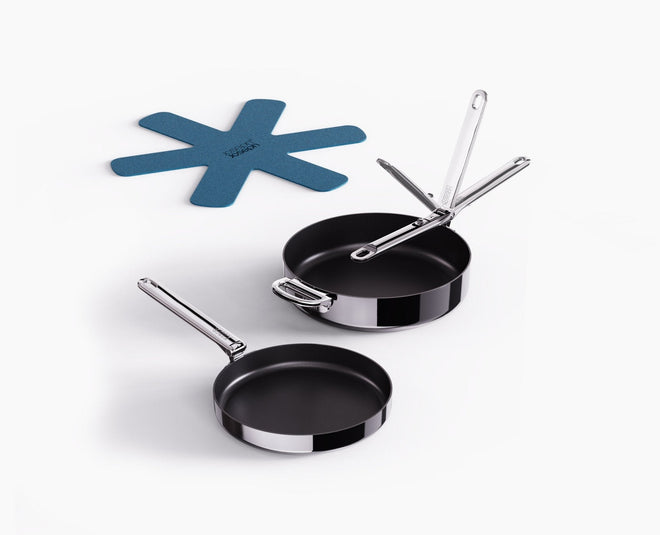
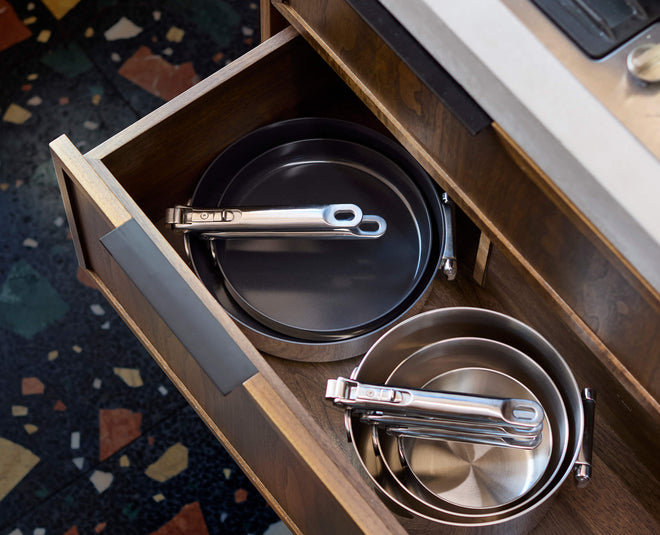
Good pans are easy to find, but good pans that are easy to store are few and far between. That’s why we invented Space cookware, our range of pots and pans with folding handles which take up half the cupboard space of normal pans. These pans stack easily, meaning your cupboards are cluttered free, and the pans are always where you expect to find them in your drawer or cupboard, so it’s easy to find the pan you need when you start cooking.
For lids and tricky items like baking trays, our pan racks, baking tray organisers, and lid organisers can be placed inside a cupboard or drawer, or attached to cupboard doors.
Protecting your pans is paramount. Using our felt pan protectors helps your cookware stay in top condition for years to come.


Caring for cookware: longevity, storage and safety
Whichever material you opt for, good care will prolong the life of your cookware and ensure it performs reliably for years. Stainless steel is long lasting, but needs careful cleaning. It benefits from deglazing with water, stock, or wine while the pan is warm to help lift any food residue. Using a non-abrasive sponge when washing up will help to keep the stainless-steel surfaces smooth. To prevent discoloration or warping, avoid sudden temperature shocks (such as running the hot pan under cold water) and align the size of your hob ring with the size of your pan.
Non-stick pans should be used with moderate heat and gentle utensils such as our silicone tongs, whisks and spatulas. Even with considered care, these pans have a lifespan of around 5 years. To know when you need to replace them, inspect the surface for visible scratches or damage and pay close attention to performance. If the non-stick pan is losing its non-stick function, this is a sign you need to replace the pan.
Whether to opt for non-stick cookware or stainless-steel cookware is the big decision. Understanding how these cookware materials perform will help you make that choice.


-
Space Steel Folding Handle 28cm Saute Pan & Lid
170,00€ -


Space Steel Folding Handle 6-Piece Cookware Set
770,00€


-


Space Folding Handle Non-Stick 5-Piece Blue Cookware Set
575,00€


FAQs
Can I use metal utensils on hard‑anodised non‑stick?
It’s best to avoid metal utensils on this type of cookware in the long term. Although hard-anodised cookware is more durable than many other types of cookware, the coating can still be susceptible to scratching or gradual wear from metal utensils, especially from sharp sides of tools like spatulas, fish slices or forks.
Why does food stick to stainless and how do I fix it?
Food sticks to stainless steel because the material has tiny pores that proteins bond with and then settle into when they hit the surface. To stop these bonds from forming and your food from sticking, you need to do three things. The first is to properly preheat the pan so that when you drop a little water on the surface it dances around like a bead. The second is to add your fat (oil or butter) to the hot pan, followed by your ingredient. And finally, you then need to allow the food to cook until it has browned and created a crust that lets it naturally release from the metal.
How long should non‑stick last and when should I replace it?
The lifespan of a non-stick pan is typically 4-5 years. You’ll know it’s time to replace it if you notice visible scratches or scuffs on your pan, or if food is starting to stick to the surface. Using silicone, wood or nylon utensils and keeping your pans on medium rather than very high heats will prolong their life.
Shop clutter-free cookware
Too many pans. Not enough cupboard. Solved.


330,00€
Space Folding Handle Ceramic Non-stick 3-piece Blue Saucepan Set


630,00€
Space Steel Folding Handle 5-Piece Cookware Set
255,00€
Space Steel Folding Handle Non-Stick 2-piece Frying Pan Set


115,00€

